Prof. Ahmed Aziz
Dean of the Engineering School, Central Asian University, Uzbekistan
2836-7863
Continuous publication
This journal follows an open-access publishing model. All accepted articles are made immediately available online without subscription barriers. No article processing charges (APC) are required.
ASPG Publisher, 625 Wright Ave, Gretna, LA 70056, USA
|
Principal Contact Adel Hussain Email: editorial@americaspg.com |
Support/Production Contact Adam Miller Email: support@americaspg.com |
Authors are required to disclose the use of generative AI tools in the preparation of their manuscripts, where applicable, in accordance with the publisher’s ethical policies.
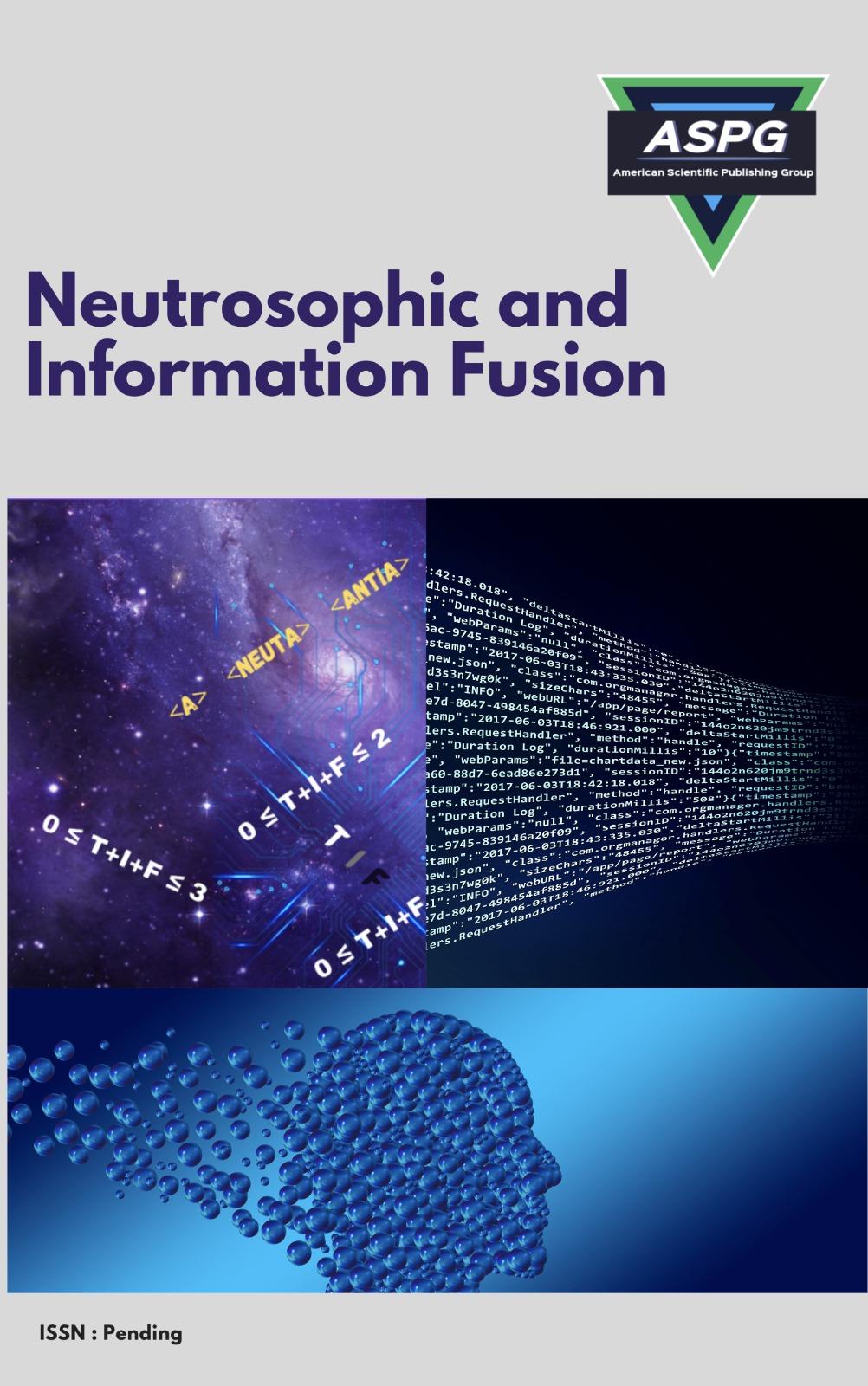
Neutrosophic and Information Fusion (NIF) is an international, peer-reviewed journal published by ASPG. The journal provides a platform for high-quality research in neutrosophic theory and information fusion, including neutrosophic sets, logic, probability, statistics, and algebraic structures, as well as their integration with data analytics, intelligent systems, and decision support applications. NIF encourages the submission of original research articles, review papers, and applied studies that advance both theoretical developments and practical implementations across interdisciplinary domains.
All submissions undergo initial editorial screening followed by a rigorous peer-review process conducted by independent experts. Further details are available in the Peer Review Process.
Authors may submit manuscripts prepared in any standard academic format. Detailed preparation instructions are provided in the Author Guidelines.
NIF is committed to maintaining high standards of publication ethics, research integrity, and transparency. Authors must ensure compliance with the publisher’s policies as outlined in the Publication Ethics and Malpractice Statement.
Submission of a manuscript implies agreement with the publisher’s copyright and licensing terms as described in the Copyright and Licensing Policy.
Neutrosophic and Information Fusion (NIF) covers the applications of Neutrosophic and Information Fusion in intelligent systems, computer science, decision support systems, and other related fields, including but not limited to:
Neutrosophic Fusion:
Information Fusion
Soheyb Milles
Laboratory of Pure and Applied Mathematics, University of Msila, Algeria.
Xindong Peng
School of Information Science and Engineering, Shaoguan University, Shaoguan 512005, China.
Xiao-Zhi Gao
School of Computing, University of Eastern Finland, FI-70211 Kuopio, Finland.
Madad Khan
Comsats Institute of Information Technology, Abbottabad, Pakistan.
Gadde Srinivasa Rao
Department of Statistics, The University of Dodoma, Dodoma, PO. Box: 259, Tanzania.
Ngan Roan Thi
Hanoi University of Natural Resources and Environment, Hanoi, Viet Nam.
Noel Moreno Lemus
Procter & Gamble International Operations S.A., Panamá.
Muhammad Akram
University of the Punjab, New Campus, Lahore, Pakistan.
Ridvan Sahin
Gümüşhane Üniversitesi, Gumushane, Turkey.
Aiyared Iampan
Department of Mathematics, School of Science, University of Phayao, Phayao 56000, Thailand.
Sadi Bayramov
Department of Algebra and Geometry, Baku State University, 23 Z. Khalilov Str., AZ1148, Baku, Azerbaijan.
Kemale Veliyeva
Department of Algebra and Geometry, Baku State University, 23 Z. Khalilov Str., AZ1148, Baku, Azerbaijan.
Tariel Khvedelidze
Iv. Javakhishvili Tbilisi State University, Tbilisi, Georgia.
Faruk Karaaslan
Çankırı Karatekin University, Çankırı, Turkey.
Karina Pérez-Teruel
Universidad Abierta para Adultos (UAPA), Santiago de los Caballeros, República Dominicana.
Kul Hur
Wonkwang University, Iksan, Jeollabukdo, South Korea.
Željko Stević
Faculty of Transport and Traffic Engineering Doboj, University of East Sarajevo, Lukavica, East Sarajevo, Bosnia and Herzegovina.
Suriana Alias
Universiti Teknologi MARA (UiTM) Kelantan, Campus Machang, 18500 Machang, Kelantan, Malaysia.
Mohammad Hamidi
Department of Mathematics, Payame Noor University (PNU), Tehran, Iran.
Lemnaouar Zedam
Department of Mathematics, Faculty of Mathematics and Informatics, University Mohamed Boudiaf, M’sila, Algeria.
Surapati Pramanik
Department of Mathematics, Nandalal Ghosh B T College, India.
Alok Dhital
The University of New Mexico - Gallup, Gallup, United States.
Ahmed Salama
Department of Mathematics, Faculty of Science, Port Said University, Egypt
Huda Khalid
Head of Scientific Affairs and Cultural Relations Department, Nineveh Province, Telafer University, Iraq.
Yo-Ping Huang
Department of Computer Science and Information, Engineering National Taipei University, New Taipei City, Taiwan.
Jun Ye
Ningbo University, School of Civil and Environmental Engineering, 818 Fenghua Road, Jiangbei District, Ningbo City, Zhejiang Province, People's Republic of China.
Ishaani Priyadarshini
University of California Berkeley, USA.
Giorgio Nordo
MIFT - Department of Mathematical and Computer Science, Physical Sciences and Earth Sciences, Messina University, Italy.
Young Bae Jun
Gyeongsang National University, South Korea.
S.A .Edalatpanah
Department of Applied Mathematics, Ayandegan Institute of Higher Education, Tonekabon, Iran.
Ripon Kumar Chakrabortty
School of Engineering & Information Technology, University of New South Wales, Canberra, Australia.
Authors are invited to submit their manuscripts through the journal’s online submission system.
Manuscripts may be prepared in any standard academic format at the initial submission stage. Compliance with a specific journal template is not required prior to peer review. Upon acceptance, manuscripts will be professionally formatted in accordance with the publisher’s publication standards. Detailed preparation instructions are provided in the Author Guidelines.
All submissions undergo an initial editorial screening followed by a rigorous double-blind peer-review process conducted by independent experts. Details of the review workflow are available in the Peer Review Process page.
Authors are required to ensure that their submissions comply with the publisher’s ethical standards. For full details, please refer to the Publication Ethics and Malpractice Statement.
NIF is indexed in the following databases:
- Crossref
- GoogleScholar
- Researchgate
- Russian Science Citation Index (RSCI)